
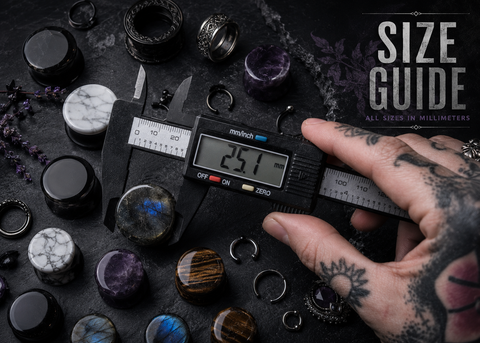
 Choosing the correct size is one of the most important steps when buying new ear plugs or tunnels. However, ear jewelry may be labeled in gauges, millimeters or inches, which can make sizing confusing—especially when different stores use slightly different conversions.
This ear gauge size chart will help you compare common measurements, understand double flare plugs and measure your current jewelry more accurately before placing an order.
Gauge Sizes vs Millimeters and Inches
The word gauge technically refers to the measurement system, while plugs and tunnels are the jewelry worn inside stretched earlobes.
At smaller sizes, ear jewelry is commonly labeled with gauge numbers such as 2g, 0g and 00g. As the size increases, most sellers begin using millimeters or inches instead.
One important detail is that gauge conversions are not always exact. For example, 00g jewelry may be listed as approximately 9mm or 10mm depending on the manufacturer. For the most accurate fit, we recommend using the millimeter measurement as your main reference.
Ear Gauge Size Chart
| Millimeters | Approx. Gauge | Decimal Inches | Common Inch Reference |
|---|---|---|---|
| 4mm | 6g | 0.157" | About 5/32" |
| 5mm | 4g | 0.197" | About 3/16" |
| 6mm | Approx. 2g | 0.236" | About 1/4" |
| 8mm | Approx. 0g | 0.315" | About 5/16" |
| 10mm | Approx. 00g | 0.394" | About 3/8" |
| 12mm | — | 0.472" | Close to 1/2" |
| 14mm | — | 0.551" | About 9/16" |
| 16mm | — | 0.630" | About 5/8" |
| 18mm | — | 0.709" | About 11/16" |
| 20mm | — | 0.787" | About 13/16" |
| 22mm | — | 0.866" | About 7/8" |
| 25mm | — | 0.984" | About 1" |
These figures are approximate. Because inch fractions and gauge standards do not always convert perfectly into whole millimeters, always check the exact millimeter size shown on the product page before ordering.
Understanding Popular Ear Plug Sizes
6mm Ear Plugs and Tunnels
A 6mm size is commonly associated with approximately 2g, although an exact 2g measurement may be closer to 6.5mm in some sizing systems.
At this size, customers can choose between solid plugs and small tunnels while still maintaining a relatively subtle look.
Explore our 6mm petrified wood ear tunnels.
8mm Ear Plugs
An 8mm plug is generally sold as approximately 0g. This size is large enough to show the color and pattern of a gemstone clearly while remaining suitable for customers who prefer a moderate stretched-ear look.
Because natural stone patterns vary, each pair may display slightly different colors, lines and inclusions.
10mm Ear Plugs
A 10mm plug is commonly associated with 00g, although some 00g jewelry may measure slightly smaller. This is why checking the exact millimeter size is more reliable than relying only on the gauge label.
At 10mm, stones such as labradorite, tiger eye and purple stone have enough surface area to show their natural patterns and flashes.
Explore our 10mm natural stone ear plugs.
You can also compare them with our 10mm chrysocolla ear tunnels for a more open tunnel-style design.
12mm Ear Plugs
A 12mm plug measures approximately 0.47 inches. It is often grouped near the 1/2-inch category, although an exact 1/2 inch is 12.7mm.
When choosing between 12mm and 1/2-inch jewelry, confirm the exact product measurement instead of assuming they are identical.
16mm Ear Plugs
A 16mm plug is approximately 5/8 inch. This larger surface area works especially well with statement materials, geode textures and stones with dramatic natural patterns.
For a more textured design, view our 16mm amethyst geode ear plugs.
What Are Double Flare Ear Plugs?
Double flare plugs have wider edges on both the front and back, with a narrower wearable area in the center. The two flared edges help hold the jewelry inside the stretched earlobe without requiring separate O-rings.
For example, a 10mm double flare plug normally has a 10mm wearable center, while the outer edges are slightly wider. The product size refers to the wearable area—not the widest part of the flare.
Double flare plugs are intended for fully healed, flexible stretched lobes. They should not be used to perform a fresh stretch because the wider flare must pass through the ear before the narrower center sits in position. The Association of Professional Piercers recommends waiting until a piercing is fully healed, matured and pliable before stretching or changing to jewelry that requires additional flexibility.
Stop if insertion causes pain, strong pressure or resistance. A professional piercer can help confirm whether your ears are ready for double flare jewelry.
How to Measure Your Ear Plugs
The most reliable tool is a digital caliper, which provides a more accurate reading than a standard ruler.
1. Measure the Wearable Diameter
Measure directly across the narrowest center section of the plug.
Do not measure the wider outer flare. If the center measures 10mm and the edges measure 11.5mm, the jewelry should normally be listed as a 10mm plug.
2. Measure the Wearable Length
Wearable length is the distance between the two flared edges. This determines how much space is available for the earlobe.
A plug that is the correct diameter may still feel uncomfortable if the wearable area is too short or too long for your lobe.
3. Measure Existing Jewelry Instead of the Open Earlobe
When possible, measure a plug or tunnel that already fits comfortably. Measuring the open space in a soft earlobe can be less accurate because the tissue may stretch, relax or change shape while being measured.
4. Check Every Product Description
Before ordering, compare:
- Wearable diameter
- Outer flare diameter
- Wearable length or thickness
- Plug or tunnel structure
- Front and back shape
- Quantity included
Natural stone ear jewelry is often carved and polished by hand, so small measurement differences may occur.
Are Plugs and Tunnels Measured the Same Way?
Yes. Both plugs and tunnels are normally sized according to the diameter of the wearable area.
The difference is in their construction:
- Plugs have a solid center.
- Tunnels have an open hole through the center.
- Double flare jewelry has wider edges on both sides.
- Single flare jewelry has one wider edge and usually uses an O-ring on the other side.
The correct choice depends on your preferred appearance, current size and how flexible your healed lobes are.
Choosing the Right Size
Before purchasing a new pair, use the millimeter measurement of jewelry that already fits comfortably. Do not select a larger size simply because the gauge or inch label looks similar.
For example:
- A 10mm plug and a 3/8-inch plug are close, but not perfectly identical.
- A 12mm plug and an exact 1/2-inch plug are not the same measurement.
- A 25mm plug is commonly sold as approximately 1 inch, although an exact inch is 25.4mm.
Using millimeters makes it easier to compare sizes and avoid unexpected differences between manufacturers.
Shop Natural Stone Ear Plugs and Tunnels
Once you know your correct size, explore our collection of handmade gemstone plugs and tunnels in labradorite, amethyst, tiger eye, chrysocolla, petrified wood and other natural materials.
Each piece is individually shaped and polished, so variations in color, flash, texture and pattern are part of the natural character of the stone.
Shop the complete Plug & Tunnel Jewelry collection.
Please note: This guide is intended to help customers compare jewelry measurements. It is not a stretching instruction guide. Consult an experienced professional piercer if you are unsure about your current size, healing condition or suitability for double flare jewelry.


